

FDI Creative Services, Inc.
Our Story
Our Story
Founded in 2005, Zupt began with a clear mission: to improve the accuracy, safety, and environmental impact of navigation and positioning systems used in complex survey operations. Starting in the onshore seismic industry, our team was frustrated by the time-consuming and disruptive nature of traditional land survey methods.
To solve this, we introduced A-PINS, a two-person inertial navigation system that drastically improved efficiency over traditional methodologies in GNSS denied areas. This then led to the creation of B-PINS, a backpack-portable inertial navigation system designed for safer and more efficient data acquisition. B-PINS has since been deployed worldwide, surveying tens of thousands of kilometers in remote, difficult environments.
Building on this success, we expanded our focus to the offshore energy industry, specifically to subsea metrology operations. Our goal remained the same: streamline survey operations, improve precision, and reduce time offshore. We developed advanced inertial subsea metrology solutions that have saved thousands of vessel hours and significantly lowered the carbon footprint of offshore construction and inspection projects.
Today, Zupt continues to innovate across the offshore energy sector, including remote metrology, subsea 3D modeling, and offshore wind monopile positioning in support of the renewables industry. We specialize in integrating inertial navigation, robotic total stations, and sensor fusion technologies to deliver accurate, reliable data with reduced offshore risk.
All of our key technologies are developed in-house by a highly experienced engineering and operations team. From early field deployment to fully remote autonomous solutions, we focus on making complex technology easy to use and delivering results faster than traditional methods.
Zupt remains a nimble, independent company trusted by global leaders in offshore energy, marine construction, and subsea inspection. Our technology helps clients reduce vessel time, improve accuracy, and operate more sustainably.
FAQ
Q: Do you sell products or services?
A: We offer both. Zupt provides offshore services with skilled personnel and specialized equipment for a variety of offshore marine construction survey projects. We also exclusively sell certain offshore products, such as Fusion Splice and MicroTTU. However, some of the sensors used in our services, like those involved in jumper metrology with our C-PINS inertial navigation system, are not available for direct sale. These are operated only by Zupt-trained personnel to deliver accurate, certified data to our clients.
Q: Where do you work?
A: Zupt works worldwide! We have local content partners worldwide with a heavy presence in West Africa and the UK. We have performed marine construction survey work in the Gulf of Mexico, the North Sea, West Africa (Ghana, Congo, Nigeria, Angola), Australia, South America, Bahamas, and more. We work off of survey vessels, platforms, or rigs.
Q: What industries does Zupt serve?
A: Zupt supports a range of industries including offshore energy for both oil and gas and renewables, marine construction, subsea inspection, and infrastructure projects that require precise metrology and positioning solutions.
Q: What makes Zupt’s technology different?
A: All of Zupt’s core inertial navigation and metrology technologies are developed in-house. This approach allows us to innovate continuously and deliver highly reliable, customized solutions that simplify complex offshore operations.
Q: How do you ensure safety during offshore operations?
A: Safety is a top priority at Zupt. We strictly adhere to industry safety standards, provide thorough training for all personnel, and regularly review and improve our procedures to ensure the well-being of our team and clients throughout every project.
Q: Can Zupt provide turnkey survey solutions?
A: Yes. Zupt offers comprehensive turnkey solutions that include skilled personnel, specialized equipment, data processing, and detailed deliverables tailored to meet the unique requirements of each project.
Q: How quickly can Zupt mobilize for a project?
A: Thanks to our experienced team and strong global partnerships, Zupt can mobilize rapidly to meet project schedules, often providing personnel and equipment on short notice to support urgent operational needs.
Quality & Compliance
Zupt, LLC is certified to the ISO 9001:2015 Quality Management System standard for the design, manufacture, sales, rental, operation, and repair of inertial positioning systems.
B-PINS V2
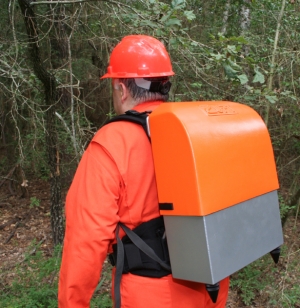
B-PINS is a precise survey tool designed to provide accurate navigation in GNSS denied areas with four times the productivity of traditional survey methods. B-PINS employs proven inertial navigation technology to provide a portable and accurate survey solution under dense canopy or urban canyon situations. The high-performance inertial sensors integrated into B-PINS deliver proven positioning accuracy significantly better than survey tolerances accepted by the international seismic acquisition community.
Product Specs
- Over 10 hours operations on a single battery set
- Continuous operations with hot swap battery
- Complete System weight ~17 kg (38 lbs)
- Job file preplot data configured for use in GPSeismic®
- Post processed survey data configured for GPSeismic®
- Operating Temperature -3°C to 55°C
- Storage Temperature -20°C to 90°C
Contact Zupt today to learn more.
B-PINS X
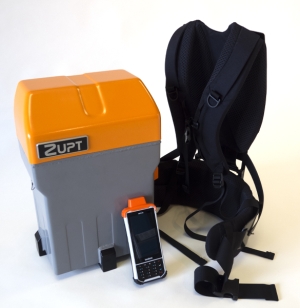
The B-PINS X is Zupt’s next generation land inertial survey system, designed for environments where GPS signals are weak, inconsistent, or completely unavailable. It delivers survey-grade accuracy through advanced inertial navigation methods, enabling reliable positioning in areas such as forests, urban canyons, or regions with heavy overhead cover. Building on the proven capabilities of earlier B-PINS systems, the B-PINS X gives surveyors a dependable solution when GNSS cannot perform.
Key upgrades include a smaller, lighter design, extended battery life with hot-swappable batteries, and integration with a handheld controller and laser range finder for efficient data collection. The system is engineered to withstand a wide range of field conditions, maintaining performance across challenging terrains and weather extremes.
These enhancements make B-PINS X a powerful tool for maximizing productivity and ensuring accurate survey results in demanding environments. Its portability reduces operational costs, while its precision opens opportunities to work in places once impractical for traditional survey methods.
Key Features
- Reduced weight & size relative to prior models.
- Long battery life: 16 hours of operation, single charge.
- Continuous operations with hot-swap battery (i.e. ability to swap batteries without shutting down).
- Wireless handheld data collector.
- Integrated laser range finder.
- Job-file configuration through GPSeismic® for pre-plot and/or post-process.
- Rugged design: durable outer shell, shock resistant, water immersion up to 30% of pack height.
Applications
- Land seismic surveys
- Pipeline right-of-way stakeouts
- Wellsite topographic surveys
- Civil engineering, forestry mapping, etc.
Advantages/Benefits
- Increased productivity in GPS-denied areas (i.e. less downtime, better performance where GPS signals are blocked).
- Reduced need for vegetation clearing (line-of-sight optical methods are less needed).
- Improved safety and ergonomic design (lighter pack, better battery, wireless).
- Real-time quality control; both in the field and post-processed accuracy.
Contact Zupt today to learn more.
Underground/Mine
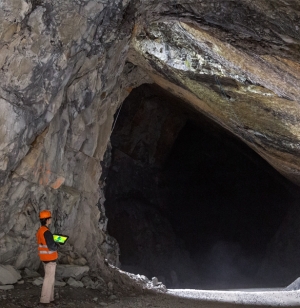
In areas with absolutely no access to GNSS signals, B-PINS is an ideal survey tool to accurately map or navigate through underground areas. B-PINS can be carried by surveyor/vehicle deep into underground mines to survey and plot a path in real-world 3D coordinates.
Contact Zupt today to learn more.
Forestry Mapping
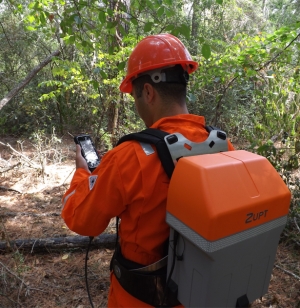
Surveys completed with the B-PINS system enable surveys to be completed in environmentally sensitive areas such as in dense forests. Because our method does not require a clear line of sight through the woods, it poses a minimal threat to trees and vegetation. The B-PINS system provides accuracy, high levels of survey productivity, with very low to no environmental impact.
Contact Zupt today to learn more.
Pipeline Right of Way
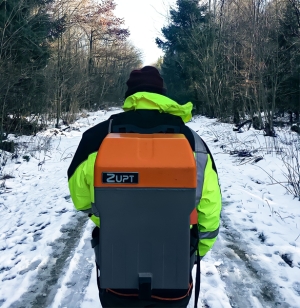
Zupt’s B-PINS deliver precise stakeout locations in harsh environments during pipeline right of way where conventional survey methods are inefficient or ineffective. Field testing by pipeline stakeout professionals determined B-PINS is the choice for getting the job done accurately and productively at the lowest cost. A surveyor simply calibrates the B-PINS, walks the pre-determined pipeline route, processes, and adjusts the data, and imports it into a modeling package for precise horizontal and vertical coordinates of the terrain.
Contact Zupt today to learn more.
Seismic Stakeout
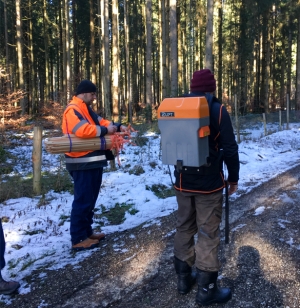
Zupt’s inertial solution, B-PINS, allows survey operations with minimal cutting while significantly increasing the production of field survey crews. During land seismic exploration, tree canopy often permits GNSS use for precise placement of survey stakes. Signals from the satellite segment of GNSS systems cannot penetrate through the tree canopy. Optical survey techniques can be used when the tree canopy or terrain limits GNSS operations, but it requires extensive cutting for a clear line of sight to operate. This cutting takes a significant amount of time and can have detrimental effects on the environment in the surveyed areas. One inertial survey crew using B-PINS can deliver the production of several conventional crews with post-survey processing results equal or better than GNSS surveys.
Contact Zupt today to learn more.
HaloCAM
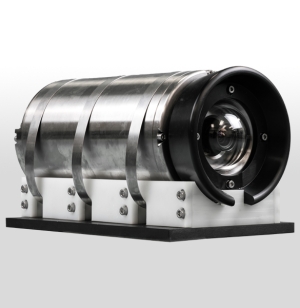
HaloCAM is a compact, 4000-meter rated sensor that delivers precise pitch, roll, heading, depth, and position for subsea structures during installation. It reduces the cost and risk of attaching expensive sensors directly to piles, conductors, or other subsea structures while ensuring accurate deployment and long-term reliability.
Inside its single 266mm x 150mm housing, HaloCAM combines an Inertial Navigation System (INS), a machine vision camera, and onboard processing. This integration provides real-time positioning and attitude data through a straightforward user interface, and the navigation engine can accept inputs from USBL, LBL, DVL, depth, or LoPs, making the system adaptable to a wide range of offshore projects. HaloCAM’s design allows it to be easily deployed on an ROV, delivering accurate updates even in challenging conditions.
By combining inertial navigation with machine vision, HaloCAM offers a reliable and efficient solution that improves safety, reduces operational costs, and enhances confidence across both oil and gas and offshore wind projects.
Benefits
- No specialized personnel required offshore, remote operation capable
- Single, self-contained unit with simple interfacing
- No lever arms to calibrate between the INS and camera
- Easy dimensional control (DC) of targets to casing—while casing is horizontal
- Deployable on small or work-class ROVs
Applications
- Well spudding
- Conductor casing installations
- Offshore wind farm monopiles
- Suction pile installations
Accuracy
- Heading: ±0.15° sec Lat.*
- Pitch & Roll: ±0.1°
- Positioning: Same as USBL/LBL *Requires DC of targets to the structure
How HaloCAM Works
HaloCAM combines a high-performance IMU with an HD camera and onboard machine vision processing to deliver the positioning accuracy the industry requires.
Mounted on the front of an ROV, HaloCAM maintains a clear line of sight to simple fiducial targets placed on the structure. The system automatically acquires the targets, processes INS and camera data internally, and provides real-time position and attitude through an intuitive user interface. The ROV can maintain a 2–4 meter standoff while HaloCAM delivers consistent updates unaffected by vibration, hammering, or jetting during installation. Targets can be dimensionally controlled and placed on flat or curved surfaces.
If the ROV has absolute positioning (USBL, LBL, or LoPs), HaloCAM translates this reference frame to the structure with the same accuracy. When not used for structure positioning, HaloCAM functions as a precise subsea INS.
Contact Zupt today to learn more.
3D Recon V2
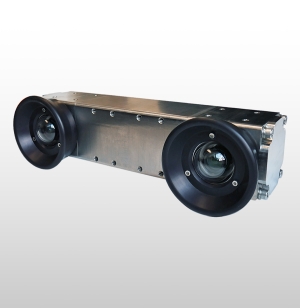
3D Recon V2 is a subsea stereo imaging system that produces high-resolution, geospatially accurate 3D models of what is seen subsea. Housed in a compact subsea enclosure rated for depths up to 4,000 meters, it features two high-resolution machine vision cameras and a high-performance MEMS IMU. By integrating inertial technology with imaging sensors, 3D Recon V2 can generate real-time sparse point clouds for navigation and quality control, as well as high-density 3D models that help engineers make informed decisions about the integrity of their subsea assets.
3D Recon V2 Applications
While 3D Recon V2 was initially developed for Integrity Management (IM) and Inspection, Repair, and Maintenance (IRM) purposes. Its versatility has since led to adoption in a range of other applications, including::
- Jumper/Spool Metrology
- Mooring Chain Link Inspection
- Hull Inspection
- Pipeline Out-Of-Straightness (OSS) Surveys
- Pre-Install/As-Built Documentation
- Real-Time Relative-to-Structure Positioning
- Real-Time Object Detection and Pose Estimation of Underwater Objects
How 3D Recon V2 Works
3D Recon V2 leverages 3D reconstruction and photogrammetry methodologies, advanced computer vision, and inertial navigation techniques to generate accurate camera poses and high-resolution point clouds of subsea assets. It supports both real-time reconstruction and highly optimized offline dense point cloud generation. Here's how each pipeline works:
Real-Time Dense Point Cloud:
- Alignment: IMU data determines the sensor's orientation (heading, pitch, roll).
- Feature Detection: Cameras capture images at 5-10Hz, and features are identified based on intensity variations.
- Feature Matching: Descriptor vectors are computed for features and used for matching between stereo cameras and sequentially from frame to frame, creating a sparse point cloud (approximately 5-10cm pixel resolution).
- Navigation Integration: The navigation engine integrates acceleration and angular velocity data to update navigation states (position, velocity, attitude).
- Global Matching: Matching features with existing ones in the map occurs.
- Position Projection: Features are projected from the camera frame to the global frame.
- Consistency Checks: Checks ensure alignment with the global map, utilizing RANSAC and optimization.
- Navigation Update: Successful feature matches update the state and covariance; new features are added to the map.
- Path Optimization: Data collection for map optimization involving keyframes triggered by specific events.
- Dense Point Cloud Generation: High-density point clouds are generated using computed position and orientation and utilize disparity maps created by comparing light intensity between the left and right cameras.
- SLAM: Camera pose, trajectory estimation, and dense point cloud generation occur in real time, allowing the operator to see their position relative to the structure, track their path, and assess coverage. When previously mapped areas are revisited, a loop closure event is triggered, correcting accumulated drift in camera pose and trajectory to ensure globally consistent dense point clouds.
Offline Dense Point Cloud:
- Feature Detection: Similar to the real-time dense pipeline, this pipeline also detects features from every image captured by the cameras but extracts higher-quality features than the real-time dense pipeline.
- Feature Matching: Descriptor vectors are computed for features and used to match every image collected. Unlike the real-time dense pipeline, this pipeline also performs non-sequential image matching.
- Structure from Motion: Structure from Motion and Bundle Adjustment algorithms are utilized to optimally estimate the 3D positions of features and the camera poses for each captured image. This process creates a sparse 3D point cloud along with the estimated camera poses at the time each image was taken.
- Dense Point Cloud Generation: High-density point clouds are generated using computed camera poses and disparity maps created by comparing light intensity between patches around sparse features across all images.
- Mesh Generation: Once the dense point cloud is generated, surface normals are computed for each point using its three nearest neighbors, which define a local plane. This process results in a highly detailed 3D model of the structure.
Real-Time Detection and Pose Estimation of Underwater Objects:
- Deep Learning model training: State of the art Deep Learning models are trained using collected and annotated data to recognize a certain object. The model learns to detect the object and generate bounding boxes and confidence scores of its predictions.
- Keypoint prediction: The model and pipeline also generate specific ‘Key Points’ used for pose estimation.
- Pose Estimation: Using known correspondences between the 2D Key Points and the corresponding object’s dimensions, the pose of the object relative to the cameras are calculated using the Perspective-n-Points algorithm.
3D Recon V2 Key Features
- Linear, Angular, and Area Accuracy: Because of the tightly coupled inertial navigation solution, 3D Recon V2 offers accurate spatial scaling within the dense delivered models. This precision ensures reliable data for measurement-based assessments.
- Change Detection: One of the key advantages of 3D Recon V2 is its ability to automate change detection. Automated Change Detection is a powerful feature that becomes accessible through the utilization of models generated by 3D Recon V2. By comparing historical 3D models, operators can monitor structural changes over time for proactive IM decisions.
- Additional Sensor Integration: 3D Recon V2 can integrate data from other sensors (Contactless CP, hydrocarbon sniffers, etc.), providing a comprehensive model or heat map for structural integrity analysis.
Deliverables of 3D Recon V2
3D Recon V2 delivers high-resolution, geospatially accurate 3D models with submillimeter pixel resolution. These precise models support the subsea integrity community in making informed decisions about structural health over time. 3D Recon V2 integrates seamlessly into existing workflows, providing high-resolution still images, conventional video, and 3D models generated both in real time for verification and offline for detailed inspection.
Data Acquisition Requirements
We require a survey mux to integrate the 3D Recon V2 spread. All power, serial communications, and image data are connected to the Mux/ROV through a single PBOF cable. It relies on one RS232 and one GB Ethernet port for configuration and data transmission. Power requirements are 24Vdc at 150W.
Product Specs
- Type of Application – Marine
- Year of Introduction – 2020
- Length - 77.9 cm
- Width - 59.4 cm
- Depth - 30.0 cm
- Weight in Air - 34Kg
- Weight in Water - 23Kg
- Power Requirement - 24VDC 6A / 150W
- Serial Communications - RS232 (230400 bps)
- Housing – Titanium
- Rated - 4,000 m
- Sensor Type - Active Pixel CMOS, Global Shutter Resolution - 2028 x 2448
- FoV Horizontal - 85°
- FoV Vertical - 65°
- Number of Frames Per Second - 5 - 10 fps Copper & 10 - 20 fps SM Fiber
- Start Up Time - 0.02 s
- Communication - 1 Gbps Ethernet Copper & 10 Gps
- SM Fiber - Single Fiber Channel
- Software – Included
- Export Image Formats - Color palletized Mesh, Point Cloud *.ply (Binary)
- Battery Type - No Battery
Real-Time Dense Reconstruction
Automated Object Detection
3D Recon V2 Latest Advancements Presentation with Danny Tapper
Contact Zupt today to learn more about 3D Recon V2 and how it can enhance your subsea operations.
Asset Identification
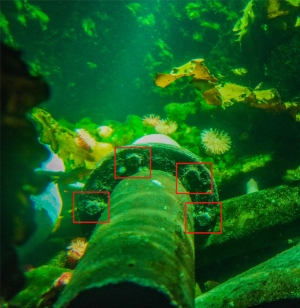
Zupt’s asset identification solutions are trained to identify certain object in practical subsea scenarios. Zupt develops and deploys software solutions that utilize Tensorflow and Yolov4 for object identification. Remove additional personnel offshore by introducing artificial intelligence packages to detect and identify assets automatically available as either topside units that utilize existing ROV cameras or complete sensor packages.
Contact Zupt today to learn more.