Get In Touch
Get in touch with us for any questions or quotes on surveying services and products. We will respond back as soon as we can.
Conventional methods can involve mounting sensors directly to the structure or pausing installation to check verticality using an ROV.
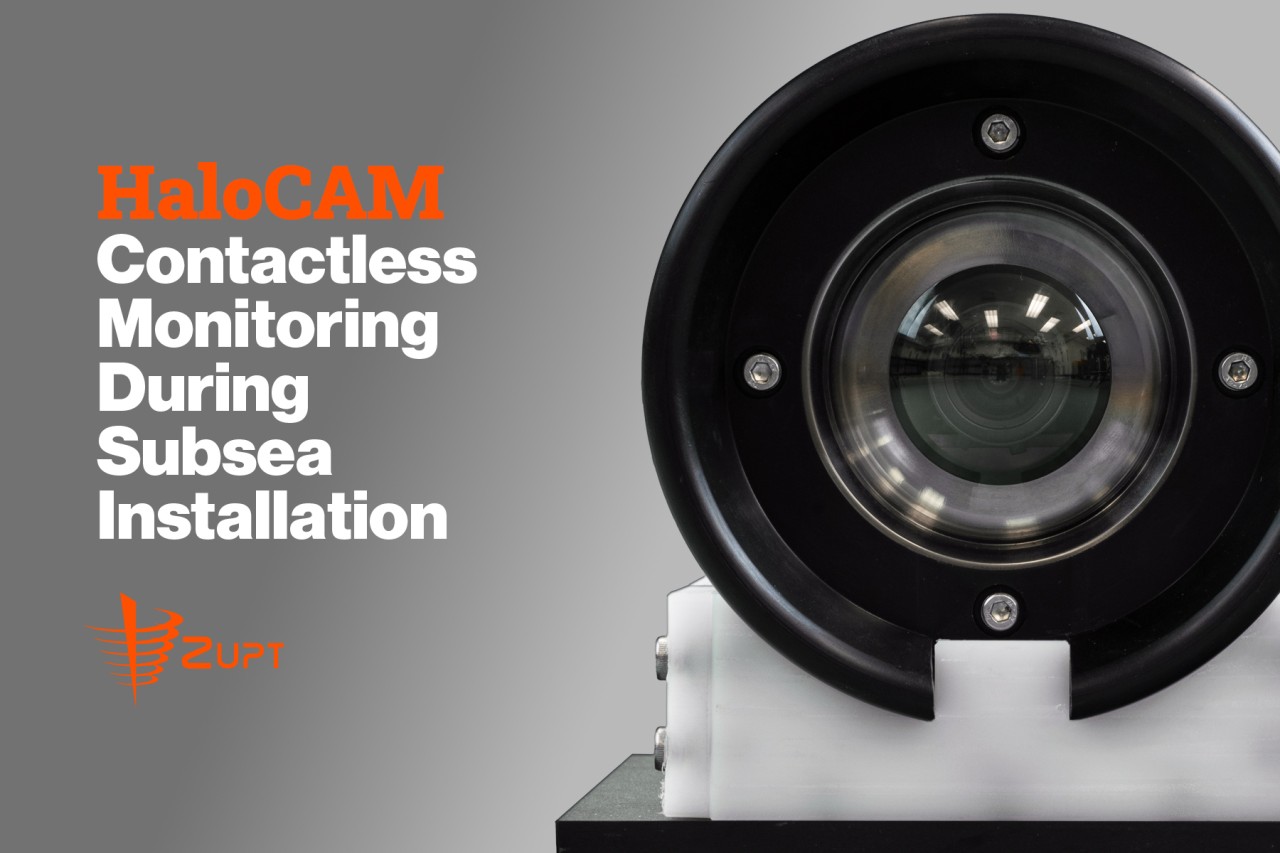
Zupt's HaloCAM combines inertial navigation with machine vision to monitor structures without attaching an active sensor to them. Mounted on an ROV, it observes fiducial targets installed on the structure and provides real-time positioning and attitude data throughout installation.
Applications include conductor casing installations, well spudding, offshore wind monopiles, and suction pile installations.
HaloCAM grew from Zupt's experience developing two technologies: its 3D Recon subsea modeling system and Halo compact inertial navigation system.
Building on that experience, Zupt integrated a machine vision camera with Halo's inertial technology to create a contactless solution for monitoring subsea structures. The combination allows HaloCAM to determine a target's orientation and position while retaining
the capabilities of a subsea inertial navigation system.
Developed to support conductor casing and offshore wind monopile installations, HaloCAM also supports other subsea structure monitoring applications.
HaloCAM integrates an inertial navigation system, a machine vision camera, and onboard processing within a single 4,000-meter-rated housing measuring 266 mm high by 150 mm in diameter.
Before deployment, fiducial targets are installed on the structure. Dimensional control establishes the relationship between those targets and the structure's reference points. This allows measurements of the target to be translated into useful information
about the structure itself.
Targets can be placed on flat or gradually curved surfaces. Dimensional control can be completed during fabrication or offshore before deployment.
Mounted on the front of an ROV, HaloCAM maintains a clear line of sight to the targets. Zupt's current operating description specifies a 2–4-meter standoff. The system automatically acquires visible targets and processes camera and inertial data subsea, presenting
position and attitude information through a topside interface.
Processing within the sensor reduces the amount of data that must be transmitted to the surface. Measurements and quality information can be delivered over a serial connection, while imagery requires an Ethernet connection and sufficient bandwidth.
HaloCAM allows the ROV to observe a structure from a standoff while installation continues. Its positioning updates are unaffected by vibration, hammering, or jetting, provided the targets remain clearly visible.
This is useful when monitoring conductor casings, monopiles, or suction piles, where crews need continuous information about inclination and orientation.
The active sensor remains on the ROV. Only the targets are installed on the structure, reducing the need to attach and recover expensive subsea sensors or their mounting hardware.
HaloCAM can determine the position and attitude of a target relative to the ROV. When an absolute positioning reference is available, it can also calculate the structure's absolute position.
The navigation engine accepts inputs including USBL, LBL, DVL, depth, and lines of position. Absolute structure positioning remains dependent on the accuracy of the supporting positioning reference.
The system can also determine stick-up height relative to a seabed reference. This requires establishing a seabed depth reference and applying the known relationship between the target and the point on the structure being monitored.
Housing the camera and inertial system together eliminates the need to measure and calibrate external lever arms between a separate INS and camera during each ROV installation.
HaloCAM can be deployed on small or work-class ROVs and does not require specialized survey personnel offshore for operation. Remote operation capability is an existing feature, supported by onboard processing and low-bandwidth transmission of measurement data.
When not being used to position structures, HaloCAM can function as a subsea inertial navigation system.
HaloCAM provides installation crews with continuous information about structure orientation and position while keeping the measurement sensor on the ROV.
Successful use depends on clear target visibility, accurate dimensional control, an appropriate camera-to-target distance, and a suitable positioning reference where absolute coordinates are required. With those requirements established, the system supports contactless monitoring across oil and gas and offshore wind installation scopes.