Get In Touch
Get in touch with us for any questions or quotes on surveying services and products. We will respond back as soon as we can.
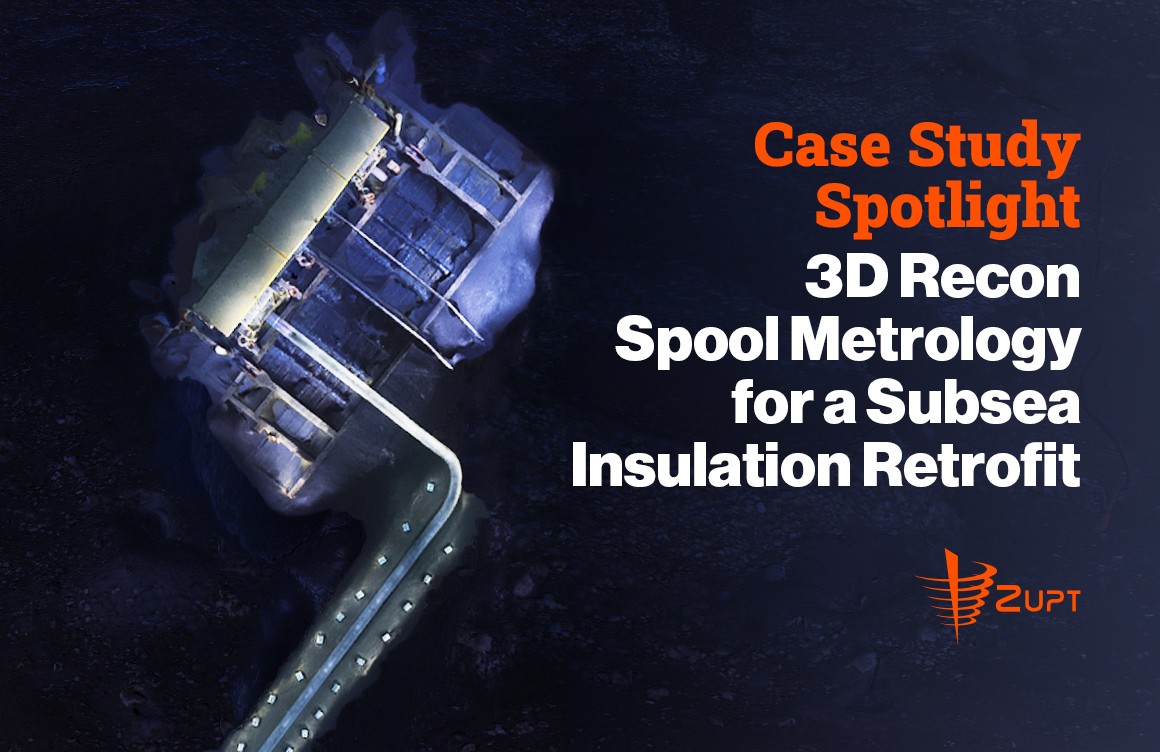
In October 2022, Zupt used 3D Recon to survey a 30-inch export spool and a nearby pipeline field joint, producing 3D models
and dimensional measurements to support the insulation subcontractor's work.
The spool connected a midline pipeline termination structure (MPTS) to a pipeline end termination (PLET) in an Australian subsea development. The planned insulation retrofit required dimensional control data from the existing installation, including the spool's
bends, changes in diameter, and clearance to the seabed.
The survey covered the spool and associated features, including a corrosion monitor, transition piece, PLET pipework, concrete mattress supports, and fiberglass reinforced plastic grating. A separate survey covered a pipeline field joint downstream of the PLET, extending two metres beyond the fusion bonded epoxy coating on each side.
The work required a model of a connected subsea installation with multiple bends, changes in elevation, and supporting structures. The field joint also required a separate model to support assessment of pipe ovality, the diameter transition between coating types, and available seabed clearance.
The dimensional data needed to describe how the pipework was installed, giving the insulation subcontractor a basis for extracting measurements from the delivered model.
Zupt mounted 3D Recon on a work-class ROV and completed an at-depth calibration before surveying. The system combined camera imagery and inertial data to support 3D modeling of the surveyed areas.
The team deployed 25 targets across the work area and divided the spool survey into four sections. Each section was surveyed before most targets were moved to the next area. Selected targets remained in place between sections, providing common reference points to tie the datasets together. This approach reduced the total number of targets required.
Following acquisition, the survey data was post-processed to produce a colorized 3D mesh model. The delivered dataset included model data in PLY and STL formats, high-resolution JPEG images, and an MP4 pseudo video assembled from the survey imagery.
To extract spool bend angles, Zupt fitted cylinders to the pipe sections on either side of each bend and calculated the angles between them. For a compound bend, the report presented measurements in plan and two vertical views to describe the geometry across all three axes.
The field-joint model was used to measure the distance from the bottom of the joint to the seabed. Multiple measurements gave a representative clearance of approximately 2.34 metres. The report noted variation of up to five centimetres depending on the joint location and seabed area selected.
The completed survey provided:
Recorded data acquisition time totalled 11 hours and 57 minutes across the four spool sections and the field-joint survey. This figure covers data acquisition only; it does not represent total project time, including calibration, target deployment, processing, or reporting.
The delivered models provided a spatial record of the existing pipework from which the insulation subcontractor could extract dimensional control data. The dataset also supported assessment of pipe ovality, coating-related diameter changes, and seabed clearance.
This project demonstrates an application of 3D Recon beyond visual inspection: capturing installed subsea geometry and extracting measurements to support engineering work on existing infrastructure.
Planning a subsea retrofit or modification? Talk to Zupt about the dimensional data your project needs.